Journal · Post #011 · Inner Work & Transformation
Forgive yourself.
The bravest sentence a person can say.
Forgiveness is not a moment. Not a feeling. Not an "Okay, it's all good." Forgiveness is an irrevocable contract with the higher self. And whoever enters into it — will never be the same again.
"As long as you have not lived the life of another — do not allow yourself to judge their path. Because you have not walked it."
— Mathias Gottwald
Editorial note: This article is based on the personal experiences, beliefs and lived life of Mathias Gottwald. All statements are subjective assessments and personal testimonies — not medical or psychological advice. Scientific studies are marked and linked as such. Protected by Art. 5 GG and Art. 10 EMRK.
Prologue
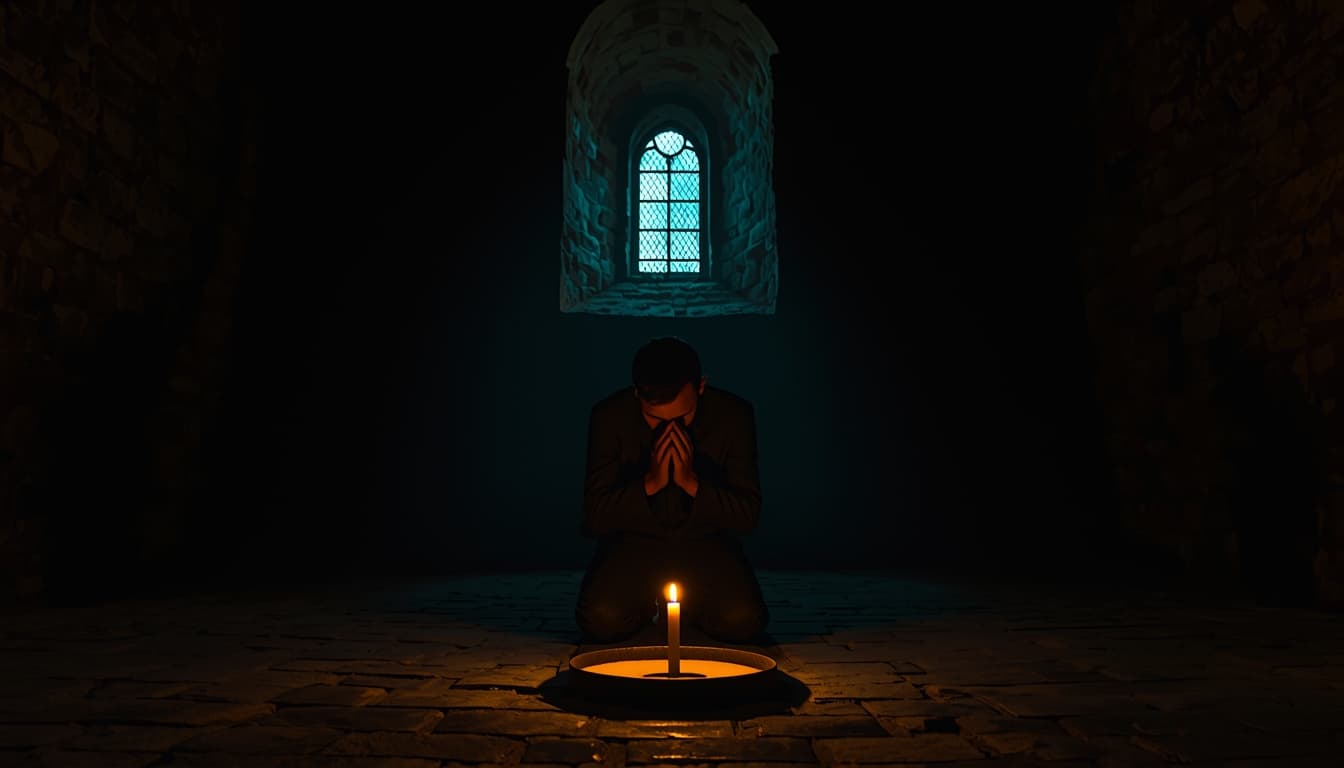
It is 5 o\'clock in the morning. December 25, 2025. A man sits in his office in Tbilisi, Georgia. A candle is burning. An empty book with lines lies before him on the desk. He doesn\'t know exactly why he woke up. He doesn\'t know what he will write. But something has awakened him. And so he takes the book in his hand.
What happens in the next 81 days — changes everything. Without exception everything. People. Perception. Interaction. Relationships. Body. View of the world. Everything.
Between December 25, 2025 and March 17, 2026, Mathias Gottwald writes in this book daily for 2 to 3 hours. He fasts for 41 days — exclusively water. He stops smoking after 28 years. No alcohol. No drugs. No media consumption. Instead: Silence. Writing. Crying. Cleaning up. And every day — Jesus.
This is not an article about self-optimization. This is not an article about mindfulness or meditation or any system that one can buy. This is a testimony. The testimony of a man who was ready to look — at everything he had done to others, at everything that had been done to him, at everything he had repressed. And who has arrived on the other side of this pain.
Chapter 01
What forgiveness is not
Before we talk about what forgiveness is — we must talk about what it is not. Because most people confuse one with the other. And because this confusion is the reason why so many people believe they forgive — and never really do.
Forgiveness is not forgetting
You don't have to forget what happened. That wouldn't be forgiveness — that would be repression. And repression is the opposite of healing.
Forgiveness is not weakness
It takes more strength to forgive than to hate. Hate is comfortable. Hate gives one the feeling of being right. Forgiveness requires courage.
Forgiveness is not agreement
Forgiving does not mean that what happened was okay. It was not okay. It remains not okay. Forgiveness changes nothing about the act — it changes your reaction to it.
Forgiveness is not a moment
Forgiveness is not a one-time act. It is a daily decision. A commitment. A path.
Forgiveness is not the absolution of the other
You don't forgive for the other. You forgive for yourself. The other doesn't even have to know that you have forgiven.
Forgiveness is not the end of pain
Forgiveness often begins with pain. One must look. One must feel. One must look at what one wants to clear away.
After 44 years, Mathias Gottwald knows not a single person — from high nobility to school colleagues to multibillionaires — who would be allowed to throw this stone. Not one. This is not condemnation. This is clarity.
Chapter 02
What science says
Forgiveness is not only spiritual. It is measurable. Science has begun to understand in recent decades what the wise men of humanity have known for thousands of years: Unforgiveness makes sick. Forgiveness heals.
Scientifically verified — Greater Good Science Center, UC Berkeley
Psychologist Charlotte vanOyen Witvliet from Hope College had subjects think about unforgiven hurts — and measured blood pressure, heart rate, skin conductance, and muscle tension. The result: Unforgiveness produces the same physiological stress response as an acute threat. The body doesn\'t distinguish between past and present. It relives the pain again and again. In real time. As if it had just happened.
Harvard Nurses Health Study — N = 70,000+ participants
People with high forgiveness readiness show statistically significantly higher social integration, more positive affect, and fewer depressive symptoms — over an observation period of up to seven years. The effect size is comparable to known interventions against depression.
Chapter 03
What the Bible says
Long before science began measuring forgiveness — the Bible described it. Not as theory. As commandment. As path. As the foundation on which everything else stands.
Matthew 6:14-15
"For if you forgive men their trespasses, your heavenly Father will also forgive you. But if you do not forgive men their trespasses, neither will your Father forgive your trespasses."
Luke 23:34 — Jesus on the Cross
"Father, forgive them — for they know not what they do."
Jesus speaks these words while being crucified. Not afterward. Not in silence. But in the moment of the greatest pain a human can experience. That is the standard. Not the memory of forgiveness — but forgiveness in the fire.
Mark 11:25
"And when you stand praying, if you hold anything against anyone, forgive them, so that your Father in heaven may forgive you your sins."
The Lord's Prayer — Matthew 6:9-13
"Our Father in heaven, hallowed be your name. Your kingdom come. Your will be done, on earth as it is in heaven. Give us today our daily bread. And forgive us our debts, as we also have forgiven our debtors. And lead us not into temptation, but deliver us from evil."
Mathias Gottwald prays this prayer every day. Not as ritual. As confession. As reminder of what it\'s about.
Forgiveness stands at the heart of the Lord\'s Prayer. Not at the margin. Not as option. As condition. As part of daily prayer. As something that must be decided anew every day.
Chapter 04
The Feedback Loop
95 percent of society lives in the past. This is not metaphor. This is psychology. And it is the reason why so many people repeat the same patterns. Same relationships. Same conflicts. Same pains.
The neurology of unforgiveness
The limbic system — the emotional center of the brain — doesn\'t distinguish between past and present. A memory of an injury activates the same neural pathways as the original injury. Those who haven\'t forgiven relive the injury daily anew — physiologically, measurably, real. Rumination — the rehashing of past injuries — is one of the strongest predictors of depression and anxiety disorders. (Psychological Science, multiple meta-analyses)
The feedback loop of life. The recurring reliving of the same pains. Same patterns. Same reactions. It keeps us where we are — not because we are weak. But because no one ever showed us how to get out. The system teaches us what we must do. Not what we should do. And a must and forgiveness don\'t go together.
Chapter 05
The Church in Georgia
There are moments in life that you cannot explain. That you can only feel. That you only understand when you have experienced them. This is one of them.
Mathias Gottwald is in Georgia with two friends. They come to an old stone church on a hill. The friends don\'t understand why one would visit a church. But they go along. At the entrance they buy honey candles. For every person to whom one owes forgiveness. For every person whose forgiveness one asks for. For every person one loves.
The friends buy more candles. More and more. Mathias takes five. And goes from trough to trough — the containers with sand in which the candles are placed. At the first candle he stands. At the second. At the third.
At the fourth candle — at the fourth trough with sand — he sees an old picture on the wall. He doesn\'t remember exactly which one today. But in that moment tears shoot to his eyes. And the only thought that remains is: the father.
"I had so much hatred in me. So much aversion. Such incredibly evil thoughts. Not just toward my father — but in general. And then in that moment in the church — the realization: Who am I to judge someone for their actions? His problems were older than I even am. My feet went soft. I knelt down. I placed the candle. And I prayed for forgiveness. For him. For me. For both of us. I haven\'t had a single negative feeling about it since."
— Mathias Gottwald
This is not a story about a father who did good. This is a story about a son who understood — that his father\'s problems were older than himself. That no one becomes evil without reason. That every perpetrator was once a victim. And that forgiveness — true forgiveness — can break this cycle.
Chapter 06
People as consumer goods
We live in a society that treats people like consumer goods. This is no exaggeration. This is observation.
As long as you are useful — you are consumed. As long as you function — you are needed. As long as you fit — you are kept. But when you change. When you grow. When you stop being what others expect of you — then you are disposed of. As if you were never there.
The psychology of rejection
Social rejection activates the same neural areas as physical pain — this has been proven in fMRI studies at UCLA (Eisenberger et al., Science 2003). Rejection. Ignoring. Exclusion. Dismissal. These are not emotional overreactions. These are real pain experiences. And every person has experienced them — as a baby, as a child, as an adolescent, as an adult. The question is not whether. The question is: What do you do with it?
Mathias Gottwald calls it the hardest realization of the journey: That many people he had always admired — whom he respected — today only deserve pity. Not because they would be evil. But because they are conditioned. Because they never learned to wake up. Because the system ensured that they never wake up.
Chapter 07
The 41 Days
41 days only water. This is not a method. This is not a biohacking protocol. This was a necessity. An inner necessity.
What fasting does to the mind
Extended fasting demonstrably reduces inflammation markers in the body and increases neuroplastic processes in the brain. Autophagy — the cellular cleansing process — begins after 24-72 hours and cleanses the body at the cellular level. But what science cannot yet fully explain: what fasting does to the mind. To perception. To the ability to see what one previously didn\'t want to or couldn\'t see.
"I didn\'t know how much I cried while filling the book. When you start cleaning up — you have to look at what dirt you want to clear away. I saw what I had done to every single person in my life. Not how severe my act was — but how severe the suffering was that I triggered. That is very sober. Because it proves how much power words possess. How much power presence possesses. How much power actions possess. And how little we are aware of it."
— Mathias Gottwald
And then — the most important realization of the entire 81 days:
This is the sentence that liberates. Not: I am evil. Not: I intentionally caused harm. But: I wanted to do the right thing — and chose the wrong way. The intention was right. The way was wrong.
Chapter 08
What true forgiveness is
Real forgiveness is not a product. No momentum. No seminar. No course. It is a decision one makes — alone, in silence, before oneself and before God.
Forgiveness is a decision
No emotion. No mood. No readiness that one must feel. One decides. Period.
Forgiveness is a process
One does not forgive once and is done. One forgives daily. Sometimes hourly. Until it sits.
Forgiveness is looking
One cannot forgive what one has not looked at. Repression is not forgiveness. Forgiveness begins with looking.
Forgiveness is feeling
One must feel how the others felt. One must go into the pain — not to suffer, but to understand.
Forgiveness is letting go
Not the other. Oneself. The pain. The bitterness. The hatred. The memory of the injustice.
Forgiveness is gratitude
For the lessons. For the strength that arose through the pain. For the path that was destined for one — not chosen, but walked.
Chapter 09
What comes after
What changes when one has truly forgiven? Everything. Absolutely everything.
"You become more honest. You become clearer. You become truer. You become more composed. You are more loving. You are more feeling. You are all these positive things. And suddenly you start seeing things in the here and now. It is no longer theory. It is no longer reflection. Everything one does, makes, says, acts — gets a felt reality. One is in the here and now."
— Mathias Gottwald
And then comes the hardest phase. Because the people around you have expected you in a certain way. They have gotten used to you — to the old you. And when you change — they no longer understand you.
That is the deepest loneliness. Not the loneliness of being alone. But the loneliness of being different — among people who know you. Or believe they know you.
But — and this is crucial — this loneliness is the price of freedom. And freedom is cheaper than the alternative. The alternative is: continue living as before. Continue conditioned. Continue in the feedback loop. Continue with the pain that never heals because one never looked at it.
Chapter 10
Great Thinkers on Forgiveness
Nelson Mandela
27 years prison. Injustice that is hardly imaginable. And then: forgiveness. Not because the others deserved it. But because he had understood: Who lives in hatred — is still imprisoned. "If I left prison and did not leave behind the hatred and bitterness — I would still be in prison."
Viktor Frankl — Holocaust survivor
"Between stimulus and response there is a space. In that space is our power to choose our response. In our response lies our growth and our freedom." Frankl forgave. Not because it was easy. But because he recognized: The only freedom that cannot be taken from a person — is the freedom to choose how one reacts.
Mahatma Gandhi
"The weak can never forgive. Forgiveness is the attribute of the strong." Forgiveness is not capitulation. It is the most courageous form of strength a person can show.
C.S. Lewis — Writer and theologian
"Everyone says forgiveness is a lovely idea until he has something to forgive." The difference between theory and practice. Between knowing about forgiveness and doing forgiveness. This difference costs everything.
Carl Gustav Jung — Psychologist
"I am not a victim of my history. I am the creator of my life." Forgiveness is the moment when one stops being a victim — and begins being a creator. Not victim of others. Not victim of the system. Creator of one's own path.
Chapter 11
The Foundation
What remains when everything else falls away?
Energy. Jesus. Yahweh. Joshua. God. Take your pick. There is only one who embodied all these values in his life and teachings — with love for one\'s neighbor at the core. And for Mathias Gottwald it was Jesus who was there every day during those 81 days. Who helped to clean up. Who helped to see. Who helped to forgive.
Chapter 12 — Epilogue
To you. The person reading this.
You didn\'t find this article by chance. There is no coincidence. You found it because something inside you is searching. Maybe you know what. Maybe not yet.
But I tell you one thing — as the person who lived this story, not as a journalist writing it down:
The pain you carry — it doesn't belong to you.
It was given to you. By people who couldn't carry it themselves.
By a system that doesn't want you to wake up.
By a society that needs consumer goods — not free people.
You can give it back. Not to the others. To God. To the Higher. To that which is greater than you and me.
You don\'t need a therapist to forgive. No app. No seminar. No method. You need silence. An empty book. A candle. And the willingness to look.
Forgive the one who harmed you. Not because he deserves it. Because you deserve it. To be free.
Forgive yourself. For what you have done. For the wrong path you walked with the right intention. For the people you ran over because you didn\'t know how to do it differently.
And then — live. Here. Now. In the moment. Not in the past that you cannot change. Not in the future that isn\'t here yet. But here. Now. With everything you are.
PLHH — Peace. Love. Harmony. for more Humanity.
A community of people who think alike, act alike and share the same values. Real World Assets. Genuine connection. Values-based technology. On the SUI Blockchain.
Explore plhh.world →Further Articles
Legal Notice
All statements in this article are personal opinions, assessments and convictions of Mathias Gottwald. Scientific studies are marked as such with source citations. This article does not replace medical or psychological advice. Protected by Art. 5 GG and Art. 10 EMRK. Owner: GOTT WALD Holding LLC, Tbilisi, Georgia.